
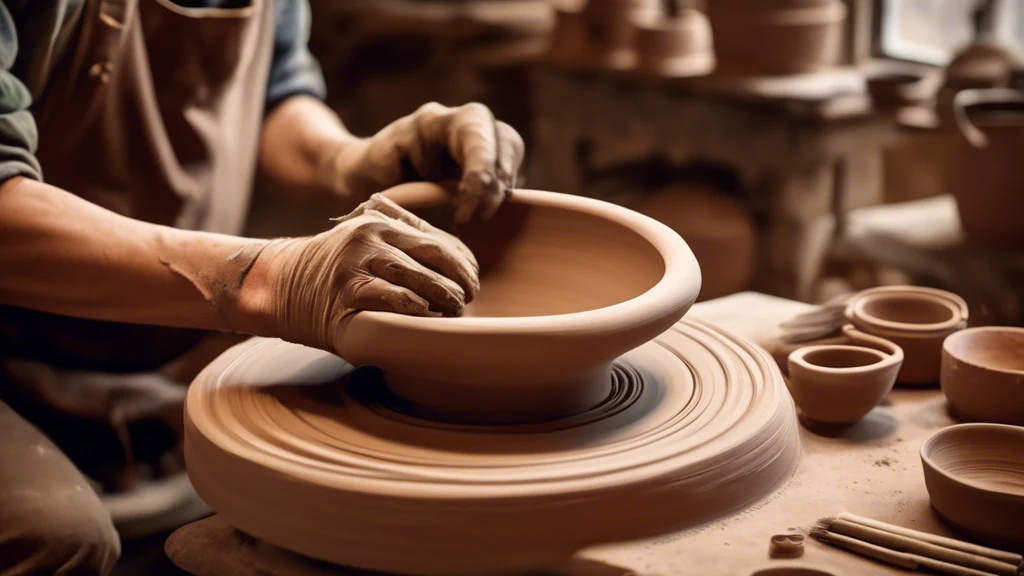
Evokes the skill and care involved in making miniature pottery, jewelry, or paper crafts

November 6, 2025
The Delicate Dance: The Skill and Soul of Miniature Handcrafts
In an age of mass production and digital saturation, there exists a realm where value is measured not in volume, but in verisimilitude at a tiny scale. This is the world of miniature handcrafts—pottery, jewelry, and paper arts—where artisans engage in a delicate dance of precision, patience, and profound care. To create a lidded pot no larger than a thumbnail, a ring set with a gem the size of a grain of sand, or a paper flower with petals thinner than a real one, is to engage in a practice that is as much about the state of mind as it is about the skill of the hand. These creations are not merely small; they are perfect reductions, capturing the essence of their full-sized counterparts through an act of intense focus and reverence for the material.
The miniature potter, seated at their wheel, does not work with spinning clay but with a stillness that borders on the sacred. A pea-sized piece of clay becomes their medium, its moisture content critical, its plasticity a fleeting opportunity. Their tools are often improvised—a needle for a trimming tool, the dampened tip of a fine brush to smooth the coil of a handle. The throwing process is not one of forceful centrifugal force, but of gentle, pin-point pressure from fingertips that must feel what the eyes can barely see. The firing of such a piece is an act of faith, as the miniature vessel faces the same elemental transformation in the kiln as a large pot, its survival a testament to the potter’s mastery over both material and process.
Similarly, the jeweler who specializes in the miniature enters a universe of amplified challenges. Setting a stone that is almost microscopic requires a steady hand guided by a magnifying loupe and a heartbeat that must not falter. The prongs of a setting are finer than eyelashes, and soldering a joint without melting the entire delicate structure is a high-wire act of thermal control. This jeweler is not just crafting an accessory; they are building a tiny, wearable architecture. The care involved is immense, as a single slip means not just a flawed piece, but the potential loss of a component that may have taken hours to create, a tiny masterpiece vanishing in an instant.
The paper artist, with their knife and tweezers, performs a kind of silent surgery. They understand the memory of paper, its grain, and its willingness to hold a fold. Cutting a perfect, intricate snowflake from a square of paper mere millimeters across requires a blade sharp enough to make a clean cut yet controlled enough not to tear the fragile fibers. Quilling—the art of rolling and shaping narrow paper strips—becomes an exercise in microscopic tension control. A miniature paper rose is assembled petal by petal, each one curled and shaped with a tool no larger than a pin, the final assembly requiring a breath held still to avoid scattering the tiny components.
What unites these diverse disciplines is the profound, almost meditative, care that underpins every action. There is no room for haste. Each step, from mixing the perfect shade of underglaze to applying a droplet of adhesive the size of a dust speck, is deliberate and considered. This slow, intentional process is a form of active mindfulness, forcing the craftsperson into the present moment. The outside world recedes, and the entire universe contracts to the space between the fingers, the tip of the tool, and the emerging micro-object. The care invested is not just about avoiding error; it is a form of respect paid to the craft itself.
This level of skill is not innate but cultivated through years of dedicated practice and a willingness to embrace failure. A miniaturist’s workshop is often littered with the ghosts of past attempts—a vase that collapsed at the wheel, a ring setting that snapped under pressure, a paper shape that was cut one micron too deep. Each failure is a lesson in the limits of the material and the hand. The journey to mastery is a slow accumulation of this tactile knowledge, a deepening understanding of how to coax a perfect form from a resistant, tiny medium.
The emotional impact of these miniature crafts is profound, both for the creator and the beholder. For the artisan, the completion of a piece brings a unique satisfaction—the quiet triumph of having wrestled a perfect form from the brink of impossibility. For the viewer, the object evokes a sense of wonder and intimacy. We are compelled to lean in, to study the work closely, and in doing so, we participate in the craftsperson’s focused world. We appreciate not just the beauty of the object, but the immense skill and care that made its existence possible.
In the end, these miniature handcrafts are a powerful testament to the human spirit’s capacity for focus and devotion. They are a rebellion against the disposable and the hurried. A miniature pot that can hold a single dewdrop, a ring that carries a secret sparkle, or a paper bloom that will never wilt—these are not trivial pursuits. They are tangible evidence of patience, a physical manifestation of care, and a quiet, enduring argument for the immense significance of the small. They remind us that the greatest demonstrations of skill are often those we must look closest to see.